
Sound into Image: The Collaboration between
David Tudor and Sophia Ogielska

Billy Klüver and Julie Martin 1996, updated 2021

David told me these are different processes: to interpret music; to compose music; to perform music; to listen to music. To look at music is a different process as well; I like to see sound as a shape and color.

Sophia Ogielska on her conversation with David Tudor [1].

 David Tudor was unique as a composer in that many of his works integrated a visual component as part of the performance. Often essential to the creation and performance of these works was Tudor’s close collaboration with other musicians, engineers, and perhaps most important, with visual artists. His instincts were sharpened through the many years he worked with John Cage and played and toured with the Merce Cunningham Dance Company, where his compositions played alongside and independent of the dance on the stage. In his own works, Tudor’s first collaboration was with Robert Rauschenberg for Elgin Tie. Tudor worked with fellow musician Lowell Cross and engineer Carson Jeffries on a sound-activated laser display system; with painter Jackie Matisse on hanging sculptures whose twistings and turnings activated sound; with Matisse and filmmaker Molly Davies on a film, Sea Tails; and in one of his longest ongoing collaborations, with a diverse group of young artists and musicians on the series of Rainforest installations and performances. His last significant collaboration with a visual artist was with Sophia Ogielska on Maps and Fragments.

In most of his collaborations the visuals were integrated into the composition by either affecting the input or using the output to generate images. Maps and Fragments are unique in the sense that they exist as physical works independent of the composition, but they also represent the music—or a version of the score of the music—in the same way the original circuit schematic or component diagram is the score of the music.

Tudor’s history of collaborations with visual artists began in 1964 with Fluorescent Sound, the first work that Tudor considered his own, when Robert Rauschenberg asked him to provide sound for Elgin Tie, Rauschenberg’s piece in a performance series, Five NY Evenings, at Moderna Museet in Stockholm. Tudor attached contact microphones to the ballasts of the fluorescent lights in the museum, and by turning the switches off and on, “played” the lights.

Two years later, when Robert Rauschenberg and Billy Klüver assembled artist friends to work with engineers from Bell Telephone Laboratories on performances for 9 Evenings: Theatre &. Engineering, it was natural to ask Tudor to participate. In his piece, Bandoneon! (a combine), the sounds from the bandoneon were picked up by contact microphones affixed to the instrument, then processed and modified by electronic equipment—some assembled by Tudor himself along with two additional systems, the Vochrome designed and operated by engineer Robert Kieronski and the Proportional Control system by Fred Waldhauer. The output was then switched between speakers and also fed to acoustical modulators placed on objects around the 69th Regiment Armory in New York. Some channels of sound output were used to control lights placed around the performance platform, turning them off and on during the performance; another channel was fed into Lowell Cross’s system that used sound to modify images on a video monitor. These images were then projected onto three large screens on the floor of the Armory. Another visual element in Bandoneon! was produced by constructions placed on remote-controlled carts that could move around the Armory. Sound was fed into transducers attached to these constructions so that they functioned as both moving speakers and “performers.” As the performance progressed, Tudor took advantage of the enormous space with its six-second reverberation time, and in effect played the entire Armory.

Tudor was one of the four core artists for the E.A.T. project to design and program the Pepsi Pavilion at Expo ’70 in Osaka, Japan. Together with Fred Waldhauer and Gordon Mumma, Tudor undertook the design of the Pavilion’s sound system, creating a system that could be preprogrammed or performed on live. The main interior space of the Pavilion consisted of a 90-foot diameter, 120-degree spherical mirror made of thin mirrored plastic film held in place by negative air pressure between it and an interior dome. Thirty-seven speakers were arranged in a rhombic grid on the surface of the dome behind the mirror. Sound could be moved at varying speeds across the dome and in circles around the dome, or shifted abruptly from any one speaker to any other speaker.
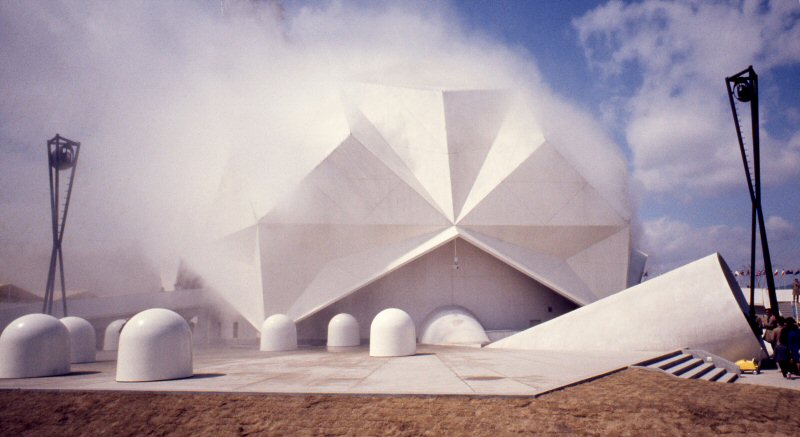
Pepsi Pavilion at Expo ’70, fog sculpture by Fujiko Nakaya. Photo: Shunk-Kender

The sound and light control console was placed on the floor of the Mirror Dome space and could be used to modulate sound inputs in real time, direct output to the speakers, and control the lights in the pavilion. Tudor, working live at the control console, made nine pieces for the dome-shaped space. Three of them, Pepscillator, Pepsibird, and Anima Pepsi,were recorded by Sony at the Pavilion.

In the early 1970s Tudor conceived another E.A.T. project, Island Eye Island Ear, a concert to be held on an island. Tudor would place parabolic antennas around the island in configurations that would create either sound beams or sound reflections. The inputs would be sounds of the island that Tudor planned to record over the course of one year. Tudor asked other artists to participate: Fujiko Nakaya to contribute cloud sculptures; Jacqueline Matisse to make and fly her long-tailed kite works; and Margaretha Åsberg to choreograph dance compositions.

In the summer of 1974, we went with Tudor to Sweden to do tests on Knavelskär, an island offered to us by Jeanette Bonnier in the archipelago outside Stockholm. We took with us two large 3-meter parabolic antennas, and a couple of smaller ones—actually metal woks, and set them up on the island. Tudor fed sound into the antennas in two different configurations, either facing each other or facing rocky cliffs, and the resulting sound was glorious: localized sound beams we could walk through or “clouds” of reflected sounds that seem to come from everywhere around where you were standing on the cliff above the antenna. We flew kites with long colorful tails that Matisse had given us from the high cliffs over the sea; Åsberg worked with movement and mirrors; and Nakaya generated voluptuous fog in several locations using seawater for the system we had assembled in Stockholm and brought to the island, which included pipes with her fog nozzles, a portable generator, and bottles of compressed air. Despite our attempts over the next several years, Island Eye Island Ear was never realized, but remains, as we put it, “the greatest concert never heard.”

Tudor’s process of constructing his musical performances was similar to the philosophy behind the development of the wireless communication system for 9 Evenings: Theatre & Engineering to control the varied functions the ten artists required for their very different pieces. Developed by Fred Waldhauer, Robbie Robinson, Herb Schneider, and other engineers with significant input from Tudor, the system consisted of small battery-driven preamplifiers, power amplifiers that could deliver 10 watts, 80 dB differential amplifiers, tone control units, FM transmitters, signal encoders and decoders, and power relays that could be arranged in different configurations for each artist’s piece.

The defining characteristic of Tudor’s music is that the source of the sounds is the behavior of the electronic circuits themselves: oscillations, amplifications, modulations, frequency filtering, attenuation, switching, phase shifting. By interconnecting discrete units that perform these various functions, Tudor built up his musical instrument.

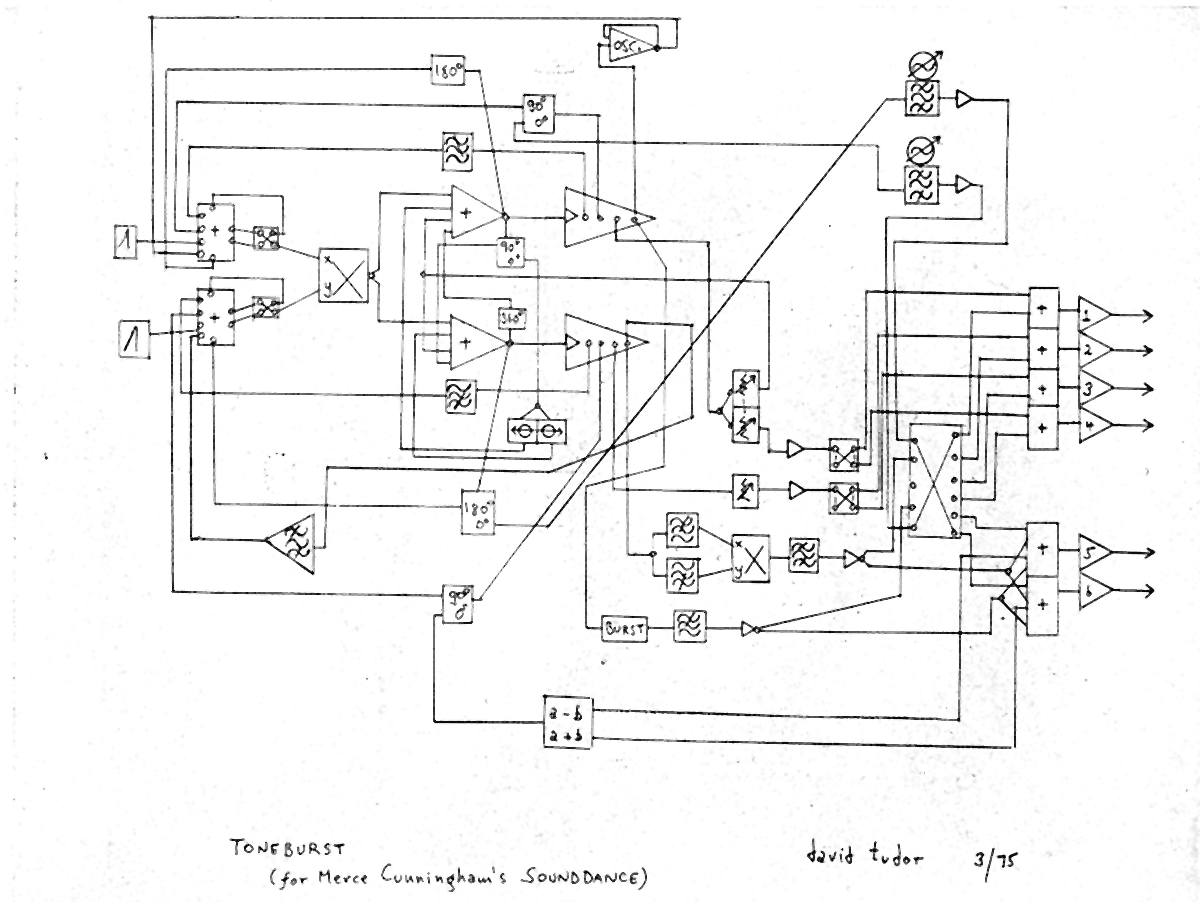
Tudor’s “scores” consist of block diagrams of circuit design, but he modified and added to the commonly used symbols—e.g., for amplifier or controls, etc.—in his own fashion, but of course carefully explaining what he meant. A typical block diagram would show: indications of the number of channel inputs; “bypass or on off controls”; modifications of the input sound, which could consist of AM modulation, FM modulation, or filters all with “vary controls”; sound modifier outputs; gain controls; clocks; and if available, preprogrammed controls. The output from all of this would be moved among as many speakers as Tudor could lay his hands on.

For a typical Tudor work, the equipment itself—potentiometers, amplifiers, filters, etc.—was housed in standard aluminum boxes or built on bread boards, all temporarily patched together to achieve the particular functions Tudor required. The functions and operation of all his equipment were well understood and catalogued in Tudor’s mind. Before each performance, he worked with prefabricated cables and connected the various electronic elements into what became one single instrument for playing. The instrument would be fabricated in front of our eyes, and Tudor’s overflowing table with its boxes, cables, batteries, and tape recorders was, with its intricacy, a fascinating and wonderful sight.

To build up his performance works Tudor relied heavily on buying equipment from mail-order catalogues, such as Federated or Edmund Scientific, and on his good friends like Gordon Mumma and Lowell Cross (who were also musicians) and engineering friends like Fred Waldhauer, Carson Jeffries, and Forrest Warthman.
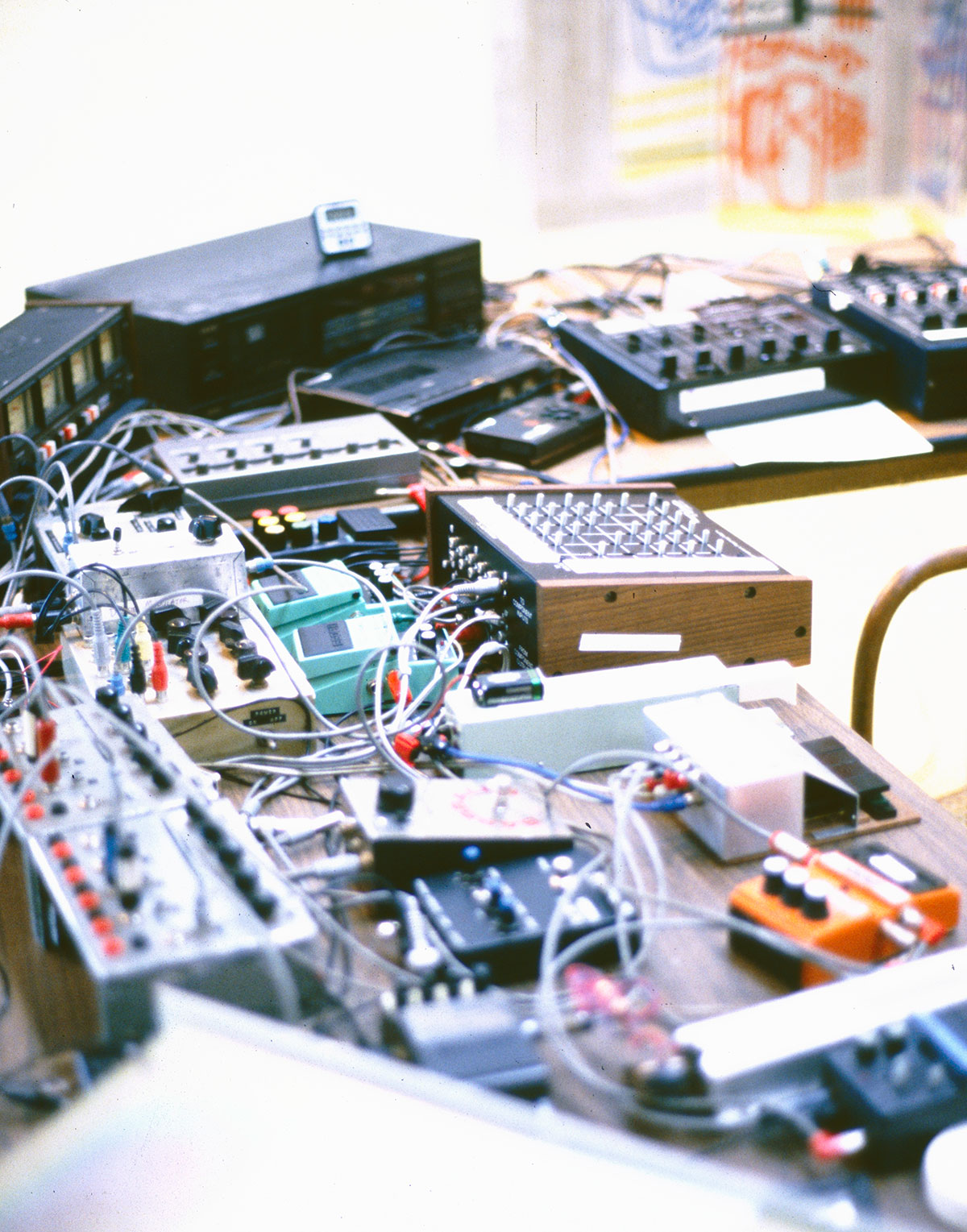
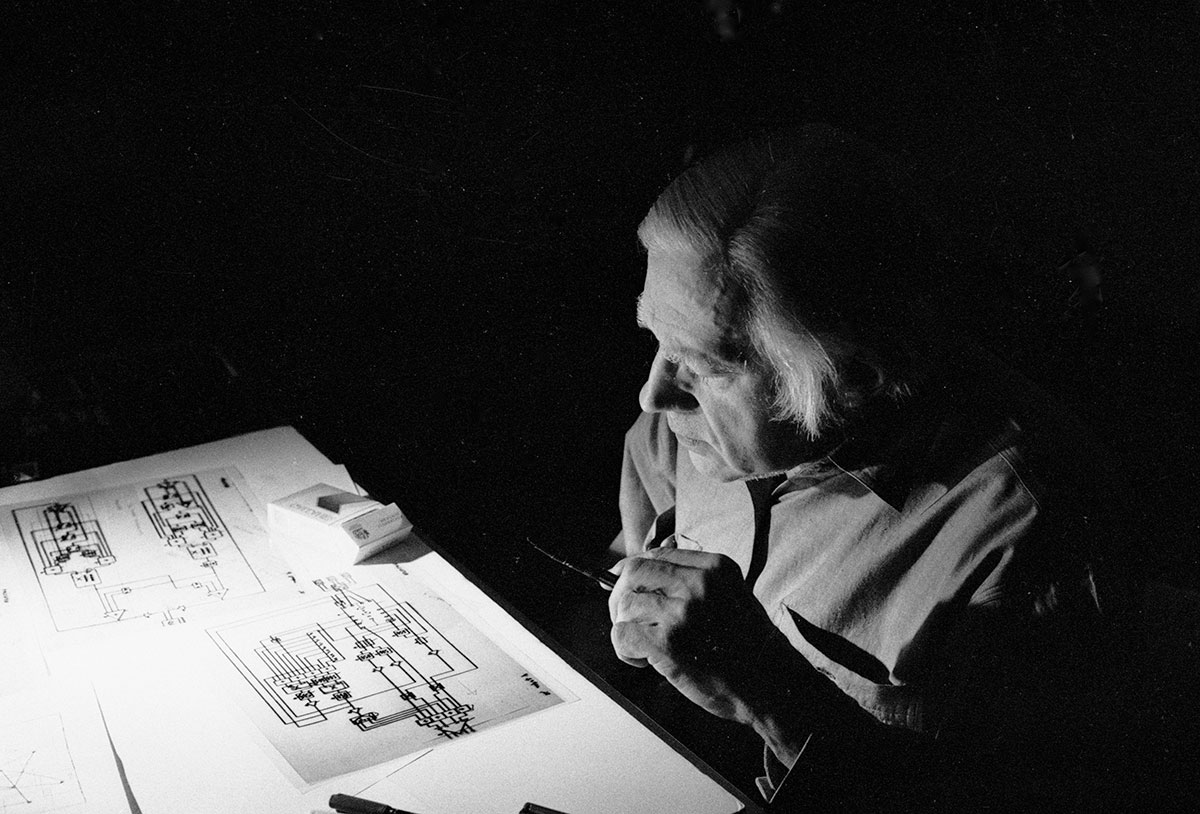
Left: David Tudor, circuit design for Toneburst (1975). Right: Arrangement of David Tudor’s electronic components for performance of Untitled/Toneburst, Zilkha Gallery 1996. Photo by Sophia Ogielska.

A sound-generating system like Tudor’s has two unique characteristics: it can be entered or triggered at any point, and the sequence of activating the components is dependent on the real-time actions of the performer. Because of inherent instabilities in the circuits, Tudor’s performance of a work could never be replicated to, say, the degree a piece of classical music could. Tudor’s music was all real-time performance by himself. As he said:

The performance is like performing the possibilities which are in front of you. And so what’s in front of you becomes the composition. And then going from that, you choose among the possibilities what you want to appear, and then it’s the task to make those things appear. So if they don’t appear at one time, then you try another time. The initial choice is: how much variety you wish there to be. So you try to make it happen or you try to arrange for it to happen. That’s what I do.[2]

Tudor was concerned with the problem of formulating and communicating how he operated, but he knew of no notation system that could adequately express the situations developing during the performance of his work. In 1994 the Merce Cunningham Company had revived Sounddance, for which Tudor played Toneburst, and the company wanted to make it a permanent part of the repertory. Toneburst is a physically demanding piece, and his fellow musician John D.S. Adams told us that in performing it, “David used every musical bone in his body.” Each performance left him exhausted and close to tears, but exhilarated.

It was at this point in time that we introduced Tudor to our neighbors, Sophia Ogielska, an artist, and Andy Ogielski, a scientist from Bell Laboratories, thinking that some of the technology that Andy had developed in his laboratory—in particular his work with neural network chips—would interest Tudor. However, when Tudor visited them in the spring of 1994, he looked at Sophia Ogielska’s paintings and immediately responded to the way she organized and presented visual information.

In her paintings Ogielska was interested in, as she put it, “a visual synthesis of complex structures … following the observation that the appeal of complexity arises neither from predetermined organization, nor from complete randomness: complex structures emerge from the interactions of their parts.” The paintings were made up of many what she called “fragments.”

The images in these fragments were abstracted from natural phenomena she had observed on trips with Andy to deserts in the American West: cracks and curls in the soil after long droughts; geodes, whole or broken, that revealed dark rings of heavy metal salts in the surrounding sandstone rock. From these smaller painted fragments she created compositions of “structured disorder” of these images of natural objects, in a process she describes:

The fragments are painted first. They are small, independent works each with its own complexity and logic. Then I build a bigger and more complex space by fitting, combining, and overlapping the earlier painted fragments. In this process of arranging and rearranging, higher-order structures emerge, structures which are unpredictable but not random.

In the complex paintings she creates, there is no focal point, no horizon, no perspective; the eye is free to move from detail to the whole, or from one detail to the next. As she says, “structure and a certain natural order emerge from visual associations imposed by the mind.”

Tudor immediately saw a correspondence between her methods of working with images and his building performance instruments from disparate parts that could be activated in many different ways. Tudor suggested that he and Ogielska develop a project together that combined sound and images. Ogielska remembers: “He told me,‘I want to see the music. I want the sound to have shape and shape to have color.’”

They started in the spring of 1994 to explore how to develop a visual representation of his music. Sophia remembers that in one of the first conversations she had with Tudor about working together, he said that whatever they created, “it cannot be a painting.”

The project took its present form when Andy Ogielski realized that “the music is in the circuits” and suggested that Ogielska ask Tudor to give her some of his circuit diagrams. Tudor gave her one diagram for the piece Untitled from 1972: Untitled [B: Performance Processing]. He also said it was his most important composition. Tudor explained that this work had a performance version, Toneburst, that premiered with the Merce Cunningham Dance Company in 1975, and “Its output configuration has a structure for eighteen minutes.” This was the minimum time he needed to present the piece, but a concert version could extend for any length of time. Tudor once played it in Europe for six hours; and he joked with Ogielska that he would love to “play it until he dropped.”

Ogielski printed this circuit diagram onto transparencies, making dozens of copies. Ogielska began experimenting with bending and twisting these transparencies, stapling several together to obtain interesting overlaps and shadows, and brought these to Tudor to show what could be achieved. He liked this direction and was delighted with the small structures with overlapping images that cast changing shadows. Thus two major parts of the project were agreed upon: they would work on a transparent or translucent medium, and the play of light and shadow would be a an important part of the resulting images. However, they did not pursue the idea of three-dimensional objects.

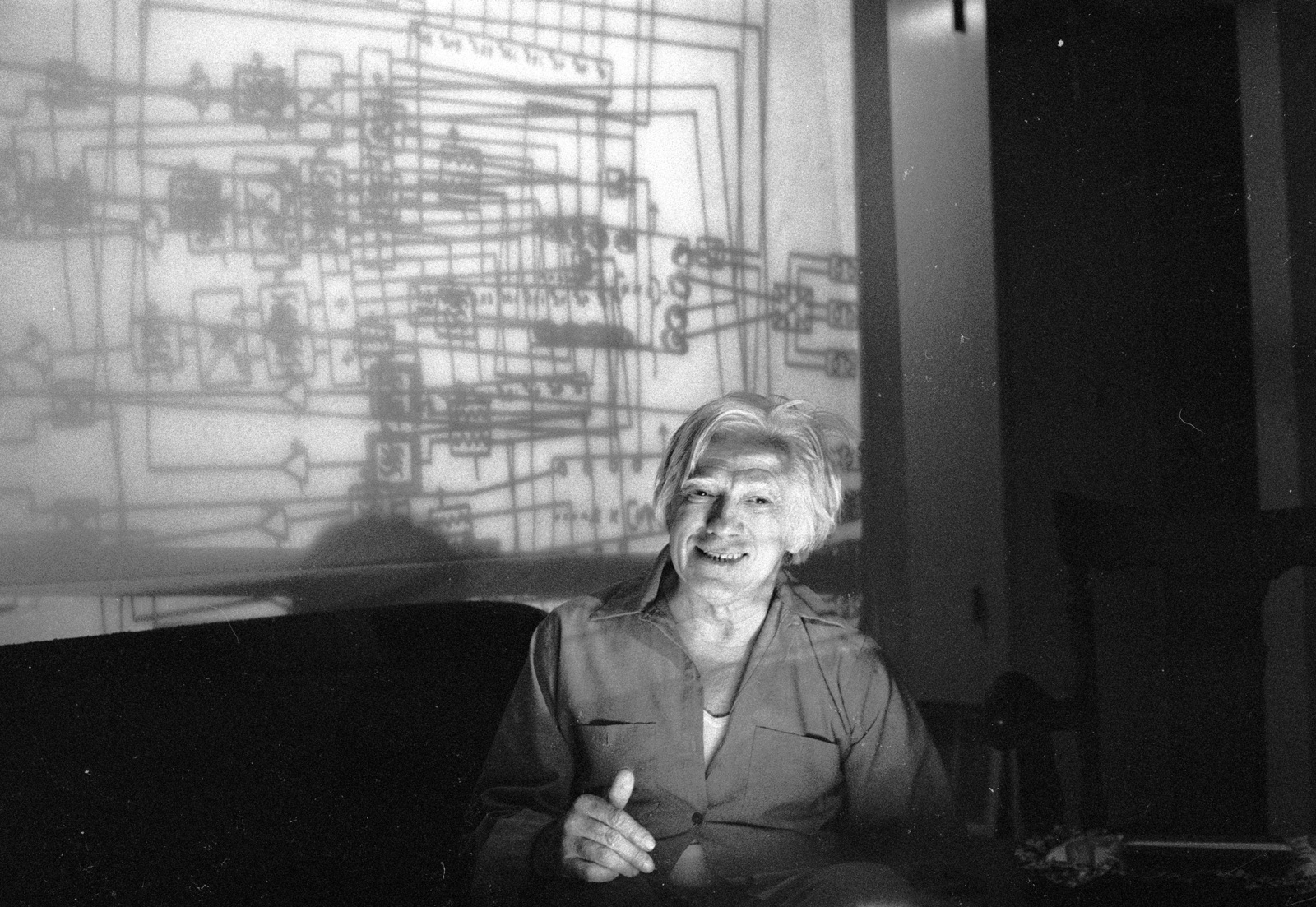
In early 1995 Ogielska took a large overhead projector that Ogielski had found abandoned in his laboratory to Tudor’s home in Tomkins Cove to project the circuit transparencies on the wall. Ogielska remembers that Tudor, who had always looked at small drawings of his scores, now saw his concert on a large wall and was “stunned” and absorbed in looking at them. They began to work with these large projections:

Standing in front of a huge projection of the transparencies, David silently began pointing at various circuit elements and tracing paths in the circuit, as if he were performing. We spent probably half a night doing this: David silently “played” the work in different “performances,” moving his hand from component to component, trying out different versions.

Left: David Tudor marking up a transparencies with his circuit design for the Toneburst Maps and fragments project, Tomkins Cove 1995.  Right:  David Tudor after his “silent concert” performed in front of large projections of electronic circuits for Untitled, Tomkins Cove 1995. Photos by Sophia Ogielska.

 She realized that from the many components in the original Untitled diagram, Tudor only activated some of them in his “silent concert.” He marked the twenty-three components that he was “activating” on a transparency. They then decided to focus on visual representations of these components, and the project moved ahead quickly on several fronts.

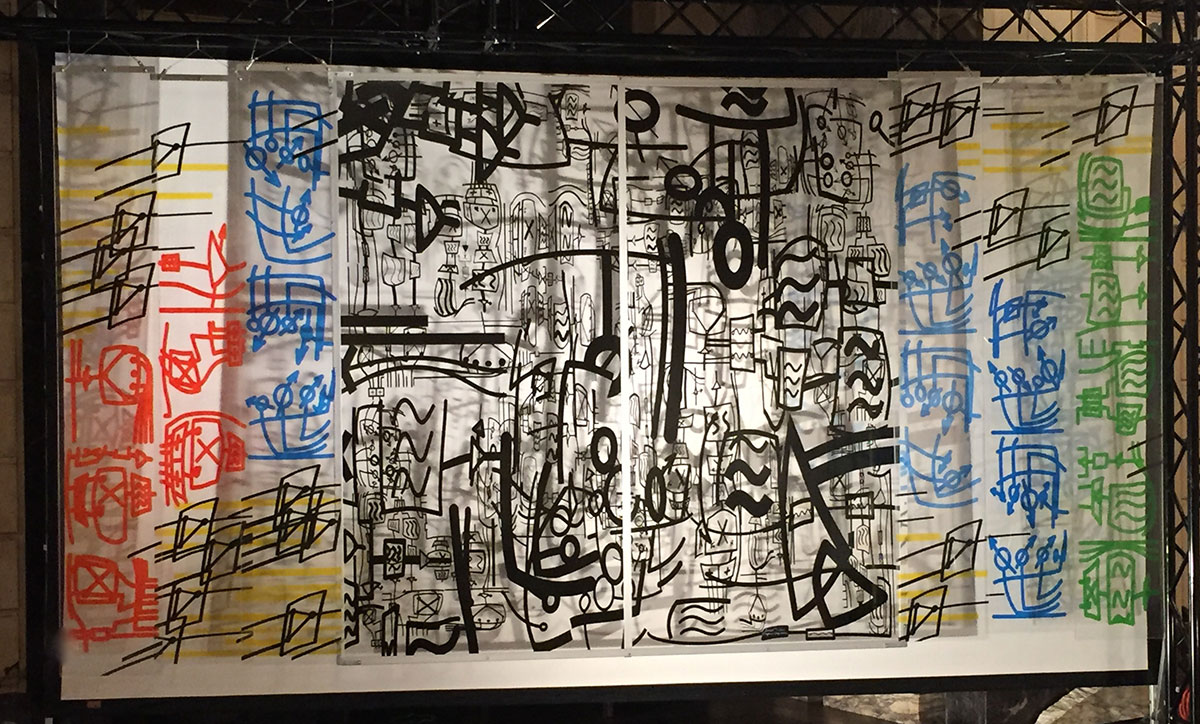
Next day after the “silent concert” Tudor decided to use bright primary colors, and he specifically assigned colors to the active components on the diagram: blue for the twelve potentiometers that controlled signal distribution, red for the six input-output switches, green for the five components of frequency control and selection and phase shift. To these were later added yellow lines to represent the constant input from tape recorders. Sophia brought color marker pens and Tudor marked the chosen colors on transparencies.

Ogielski at the time was writing an interactive graphics program using spline functions, where a transformation brings a two-dimensional image onto a surface in three dimensions, to assist research projects in a neurobiology lab. With the program you are then able to manipulate or shape this image in three-dimensional space—enlarging and/or elongating it in any direction, folding it in on itself, etc. The manipulated image is then projected and drawn on a two-dimensional surface. To test his program, Ogielski input Tudor’s Untitled circuit diagrams and performed some simple manipulations on them. When Ogielska showed the results to Tudor, he loved the idea of working with the program—conceptually and visually. They began to work together to evolve new shapes for each of the twenty-three active components. Tudor and Ogielska demanded that the surfaces and the appearance of the shapes become more complex, and Ogielski was required to expand his program several times to keep up with them. Ogielska learned the program and would produce images to show Tudor, or they would sit together at the computer and manipulate the shapes on the screen.

They worked with the program to transform the images of those twenty-three components. According to Ogielska: “We were manipulating images until we both agreed that they looked and sounded good. I would say ‘That looks good,’ and David would say, ‘That sounds good.’”

Tudor was delighted with the lively, colorful, almost cartoonlike graphic shapes, which they called ideograms, and he told her, “Well, now we can put them together.” Using the computer program, Ogielska wrote, “We started manipulating those components into sequences, as he would play them in a concert in real life.” The ideograms were like letters, and then the circuits on the maps made up of these ideograms were sentences that Tudor could read … and hear. He declared, “Now I have a language.”

Over the next several months they essentially used the same method of composition that Ogielska used in her paintings. They manipulated different images of the diagram or of parts of the diagram made up of the ideograms, stretching some and shrinking others, until Tudor liked the sound and Ogielska liked the image. Then they assembled the many different forms of the diagrams into a large square space, fitting them together, as Ogielska has said, “like a puzzle.” They continued adding different versions of the diagrams until they had built a Map that satisfied both of them.

The Maps increased in complexity as they created successive versions. The first, Map 1a was various circuits or fragments of them in black. Map 4, also in black, included another layer of larger images of components. It demonstrated the potential of overlays, and possibilities of moving toward color overlays.

Since Tudor operated on a number of electronic components at the same time during his performances, Ogielska and Tudor had decided to use transparent media carrying images that could be laid on top of each other to represent the multiple simultaneous operations. The use of multiple layers and color shadows became a natural element of their work.


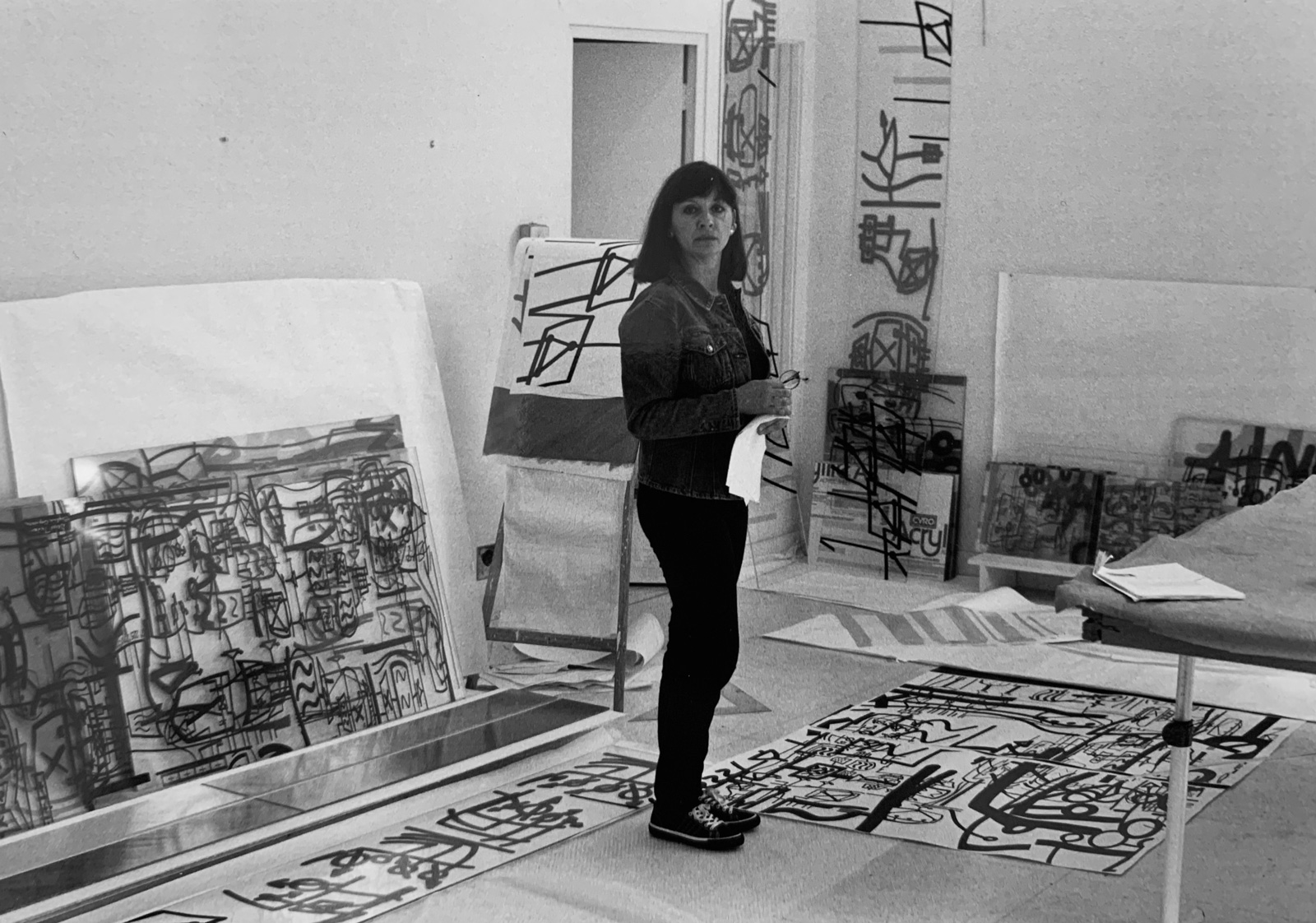
Left: Sophia Ogielska in her studio, 1995.  Right: David Tudor and Sophia Ogielska, Map 4 and Ideogram Cluster, shown at Issue Project Room Gala, Brooklyn, 2016. Photos by Andy Ogielski and Sophia Ogielska.

Ogielska turned to the question of producing the designs they had created in the computer. She talked this over with us, and Billy Klüver had the idea to call Bob Rauschenberg and ask if he knew of any new, interesting materials that they could use, transparent material that also could scale to larger sizes. Rauschenberg mentioned a technology that he and his studio assistants had considered but had not used, electronic cuttable vinyl film, and he thought it was worth exploring.

We began to research this material and how it was being used. We found a source of supply of long rolls of vinyl film in a variety of widths and also a small shop in our town of Berkeley Heights that used a computer-controlled cutting machine to cut the computer-based images out of thin vinyl that could then be applied to large acrylic panels. Ogielska set up a large table in her studio and laid the 8-foot sheets of acrylic on it. The task was daunting, as the black images were cut in multiple pieces and had to be peeled from their backing and then laid onto the correct place on the large acrylic surface. It was, Ogielska has said, like gluing large pieces of lace with no margin for error.

The Maps present the various ways single components were connected in multiple configurations and thus the many ways David could play the concert. Ogielska noted: “The Maps can be read from any direction. You can enter into a Map from any point and move in any direction among the components to create any performance sequences. It is open to a multitude of interpretations.“

The two maps they produced in their final versions were Map 1 and Map 4, in which all the elements were black, although Map 4 added another layer of enlargements of some of the components. They wanted the Maps to be large, and Toneburst Map 4 measures 96 x 96 inches. The dimensions of the Maps can be variable, and although Toneburst Map 1 Version 2 was also designed for a 96″ x 96″ size, it was produced divided into three sections, each of which measures 85.5″ x 29.5″, for a site-specific exhibition in Ezra and Cecile Zilkha Gallery at Wesleyan University. The other three Maps remain in the design stage.

At the same time, Ogielska was exploring how to add the color images and layers to the Maps. Most important, the colors had to be translucent and cast colored shadows. She found a paint that satisfied these requirements and used the painted clear vinyl material to introduce color in two ways.

She also introduced color into works that she called Fragments, which she undertook as studies on how to incorporate layers of color into future large Maps. Each Fragment was a detail from a Map, in which each of the large-scale overlaid components appeared in its appropriate color. Each Fragment was made up of between four and seven acrylic panels, some of them as large as 48 x 32 inches, each panel with a cut-out image of one color: there was one panel with the black image of a circuit and then other panels each carrying enlargements of color images of multiple ideograms or their parts. She brought an early Fragment with its multiple panels to Tomkins Cove to show Tudor. He encouraged her to keep the layers separate, so that many variations of the Fragments could be assembled, changed, and reassembled. Ogielski then designed special frames so that multiple panels could be inserted and  their order changed.

Sometime after Ogielska began producing the Fragments, Tudor began to gradually lose his sight following a series of strokes. This did not diminish his interest and involvement in the project. Ogielska would describe what she was doing, and together they would decide on the next steps. He would trace the raised vinyl shapes of the ideograms on the various layers of the Fragments. He joked, Ogielska remembers, “Now that I can’t see, I’m a visual artist.”

The first installation of Toneburst Maps and Fragments, together with a performance of Toneburst by John D.S. Adams, was in the Zilkha Gallery at Wesleyan University in 1996. Tudor and Ogielska visited the space; Tudor listened to the acoustics of the gallery and planned the sound space, while Ogielska developed ideas for installing the visual elements leveraging the architecture of the gallery. The opening of the exhibition and the performance of Toneburst took place almost exactly one month after Tudor’s death.

Tudor’s original block diagrams described the “instrument” he used to perform Untitled and Toneburst. The Maps andFragments and Ideogram Clusters that Tudor and Ogielska created can be seen as descriptions of the possibilities inherent in multiple performances of the works. Tudor felt that they had created a visual language through which the performance of his work could be described. The Maps can be read as scores that can be entered at any point and traversed in any direction, producing, in effect, one performance as well as many performances. As evidenced in recent installations, the collaboration among Sophia Ogielska, Andy Ogielski, and David Tudor produced bright, energetic works that not only act as a visual equivalent of his music but also are the visual expression of Tudor’s commitment to multiplicity, choice, and responsibility that guided his work and his life.

©  Billy Klüver and Julie Martin 1996. Edited and material added by Julie Martin 2021.

[1] The quotes by David Tudor are from notes taken by Sophia Ogielska during their work together and from recent interviews with Sophia Ogielska by the present author.

[2] From an annotated bibliography compiled by John Holzapfel, who has written extensively on Tudor’s early performance work, “Composer Inside Electronics: David Tudor im Gesprach mit David Fullemann,” MusikTexte 15 (July 1986): 11–17.